Material gratuito
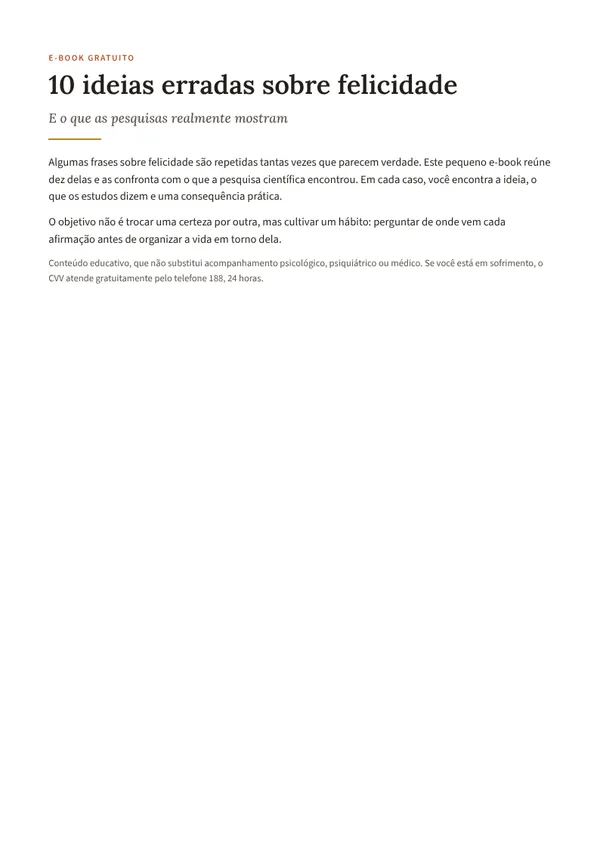
10 ideias erradas sobre felicidade
E-book em PDF, tamanho A4 · 5 páginas
Dez crenças populares sobre felicidade, cada uma confrontada com o estudo que a confirma ou a desmente e com uma consequência prática. Uma leitura de quinze minutos, com todas as referências ao final, para cultivar o hábito de perguntar de onde vem cada afirmação.
Livre para imprimir e compartilhar, desde que sem alterações e sem fins comerciais. Cada página traz no rodapé o autor e o endereço desta página.
Fontes usadas neste material
- BONANNO, G. A. Loss, trauma, and human resilience: have we underestimated the human capacity to thrive after extremely aversive events? American Psychologist, v. 59, n. 1, p. 20-28, 2004.
- BRICKMAN, P.; COATES, D.; JANOFF-BULMAN, R. Lottery winners and accident victims: is happiness relative? Journal of Personality and Social Psychology, v. 36, n. 8, p. 917-927, 1978.
- BROWN, N. J. L.; ROHRER, J. M. Easy as (happiness) pie? A critical evaluation of a popular model of the determinants of well-being. Journal of Happiness Studies, v. 21, n. 4, p. 1285-1301, 2020.
- DUNN, E. W.; AKNIN, L. B.; NORTON, M. I. Spending money on others promotes happiness. Science, v. 319, n. 5870, p. 1687-1688, 2008.
- GROSS, J. J. Antecedent- and response-focused emotion regulation: divergent consequences for experience, expression, and physiology. Journal of Personality and Social Psychology, v. 74, n. 1, p. 224-237, 1998.
- KAMIYA, M. Ikigai ni tsuite. Tokyo: Misuzu Shobō, 1966.
- KILLINGSWORTH, M. A.; KAHNEMAN, D.; MELLERS, B. Income and emotional well-being: a conflict resolved. Proceedings of the National Academy of Sciences, v. 120, n. 10, e2208661120, 2023.
- LALLY, P. et al. How are habits formed: modelling habit formation in the real world. European Journal of Social Psychology, v. 40, n. 6, p. 998-1009, 2010.
- LYUBOMIRSKY, S.; SHELDON, K. M.; SCHKADE, D. Pursuing happiness: the architecture of sustainable change. Review of General Psychology, v. 9, n. 2, p. 111-131, 2005.
- OPHIR, E.; NASS, C.; WAGNER, A. D. Cognitive control in media multitaskers. Proceedings of the National Academy of Sciences, v. 106, n. 37, p. 15583-15587, 2009.
Leia também
Guia
Felicidade é genética? O que dizem os estudos com gêmeos
Parte da felicidade vem dos genes, mas quanto? Os estudos com gêmeos, o mito dos 40% sob seu controle e a margem real que sobra para agir.
Ler o guia →GuiaPor que a alegria de uma conquista passa tão rápido?
A adaptação hedônica explica por que o carro novo, a promoção e até o prêmio da loteria perdem o brilho. E mostra o que resiste melhor a esse desgaste.
Ler o guia →